Starting a lifestyle change or undergoing a weight loss procedure is a brave decision and a major step toward well-being. However, the path to physical transformation often presents anatomical challenges that go beyond the scale and require a realistic, medical perspective.
For many people, a weight loss plan (whether through diet and exercise, bariatric surgery, or a combination) is the first step to improving health and body image. But when losing a significant amount of weight quickly, side effects frequently appear on the figure, such as loss of skin firmness.
When fat deposits decrease at high speed, the skin loses its natural retraction capacity due to the breakdown of collagen and elastin fibers. This lack of adaptation can cause frustration when seeing that your silhouette does not reflect all the effort made.
Therefore, in this article, we will analyze the body areas most vulnerable to skin sagging, why loose skin appears, and what medical and surgical body contouring solutions exist to restore firmness to your silhouette safely and permanently.
Why Does Sagging Skin Appear?
To understand why the skin loses its firmness and sags, it is very useful to imagine the dermis as an elastic garment supporting our body. If that garment is stretched too much or for too long, it loses its ability to shrink and regain its original shape.
This is exactly what happens in our skin from a medical standpoint:
- Initial distension: When our body gains weight, excess fat stretches the skin. We experience a very similar process after pregnancy, where the skin and tissues suffer very intense stretching over a very short period.
- Deterioration of internal structure: To keep skin firm and elastic, two essential proteins are needed: collagen and elastin. However, during weight gain, collagen and elastin generally decrease due to poor nutrition at that time. If we add other factors like poor diet, excessive sun exposure, alcohol consumption, etc., the structure supporting the skin gradually weakens without us noticing.
- Rapid volume loss and the age factor: The problem becomes evident when we lose weight. Following rapid weight loss, collagen and elastin tissues weaken even further. Fat disappears, but the skin, having lost its elasticity, remains “empty” and fails to retract. Additionally, at this point, patient age becomes another factor, since collagen production naturally decreases over the years, making it harder for tissue to return to its place on its own.
In short, body skin laxity is the direct result of altered elastic fibers and prolonged stretching. For this reason, when sagging is moderate or severe, cosmetics and exercise are insufficient, making a medical or surgical evaluation necessary to remove excess skin and restructure the figure.
Which Body Areas Suffer Most from Sagging After Weight Loss and Why?
Although volume loss benefits the entire organism, skin does not respond with the same elasticity in all parts of the body. There are areas where the dermis is thinner, muscle support is lower, or gravity acts with greater force.
For these anatomical reasons, the body areas most affected by skin sagging after weight loss are:
- Double chin and eyelids: The skin on the face and neck is especially thin and delicate. Upon losing the fat supporting it from within, eyelid dermis folds easily and double chin skin sags due to gravity, blurring facial contours.
- Inner arms and inner thighs: On the inner side of extremities, skin has fewer collagen fibers and is thinner. When fat or muscle volume decreases, tissue fails to adapt and hangs in folds.
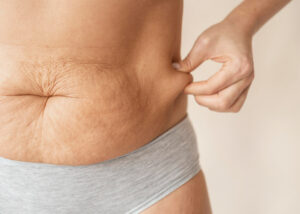
- Abdomen: This is the area experiencing the greatest distension, whether from weight gain or after pregnancy. Losing volume quickly causes maximally stretched skin to lose its retraction capacity and drop in folds over the pubic area.
- Buttocks: Losing the adipose volume that shaped them deprives the skin of internal support. This causes the buttocks to lose projection, flatten, and sag over the lower crease.
What Can We Do to Tone the Skin and Reduce Loose Skin from Weight Loss?
Ideally, the skin would return to its usual state naturally. When achieving such a major goal as losing weight, it is desirable for the body to readjust on its own to the new silhouette.
However, it is a process that takes time, and in cases of massive weight loss, full natural recovery of the figure is virtually impossible, as irreversible distension occurs in the skin.
To put it simply: skin has an elastic limit. When stretched intensely over a prolonged period or after pregnancy, internal collagen and elastin fibers break. Strength training helps tone underlying musculature, but it lacks the capacity to shrink or eliminate excess loose skin that has lost its elasticity.
For this reason, the natural path has limited reach. To achieve real, definitive firmness, the alternative involves evaluating dermal stimulation treatments in mild cases, or body contouring surgery (such as abdominoplasty or body lifts) to remove excess skin and restore harmony to your silhouette.
Are you looking for effective procedures against sagging?
Visit our skin treatments section
Procedures to Combat Loose Skin at Home
To care for skin quality after losing weight or after pregnancy, daily habits help nourish tissue and improve its overall appearance from home. However, to avoid false expectations, it is fundamental to understand what each can achieve and their biological limits:
- Strength training: Muscle mass acts as natural skin support. Toning deep muscles helps firm the area and improve tissue metabolism. However, it is not a foolproof solution: exercise strengthens muscle, but cannot contract or eliminate excess skin.
- Nutrition and hydration: What we ingest directly reflects in the dermis. Maintaining a diet rich in antioxidants, vitamins, and biotin promotes natural collagen production. Additionally, drinking at least 2 liters of water daily is indispensable to maintain tissue elasticity and flexibility from within.
- Exfoliation and massages: Applying exfoliants through circular massages helps remove dead cells and stimulates superficial blood circulation, improving skin texture and facilitating product absorption.
- Firming cosmetics: Consistent application of creams formulated with collagen or retinoids delivers key nutrients to outer dermal layers. Retinoids help stimulate cellular renewal and improve skin density.
All these habits require time, consistency, and discipline. While excellent for caring for skin health and surface appearance, they are insufficient in cases of moderate or severe sagging.
When massive weight loss or extreme stretching has occurred, home routines cannot retract excess skin. In those scenarios, the only effective alternative to remove excess tissue and reshape the figure requires a specialized medical evaluation to determine the appropriate aesthetic medical or surgical treatment.
Aesthetic Medicine Procedures to Combat Sagging Without Surgery
For those presenting mild or moderate sagging (or seeking to prevent early looseness), aesthetic medicine offers highly effective non-invasive alternatives. These treatments require no operating room or downtime, focusing on stimulating cellular regeneration and tissue firmness from within:
- Collagen biostimulators: Procedures based on substances like calcium hydroxylapatite or poly-L-lactic acid. Infiltrating product into deep layers triggers natural collagen and elastin production, restoring skin density and generating a progressive tightening effect.
- Body and facial radiofrequency: Applying controlled heat to the dermis contracts existing fibers and stimulates new collagen synthesis, compacting tissue and improving skin firmness.
- Mesotherapy and biorevitalizations: Combinations of non-crosslinked hyaluronic acid, vitamins, and amino acids applied via microinjections. They provide deep hydration and markedly improve skin quality, thickness, and radiance.
- Medium or high cross-linked hyaluronic acid: Used strategically to restore lost volume or support facial and body structures that have yielded slightly.
These techniques offer excellent results in patients with initial sagging or moderate weight changes. However, being realistic is essential: when severe excess skin exists (skin aprons following massive weight loss), aesthetic medicine cannot retract all surplus tissue. In those cases, body contouring surgery becomes the only definitive path to remove excess skin and restructure the silhouette.
Are you interested in any of these treatments? Schedule your appointment with no obligation.
Surgeries to Combat Loose Skin After Weight Loss
For the most severe cases of sagging caused by major weight loss or post-bariatric surgery, aesthetic medicine is not enough. In these scenarios, plastic surgery becomes the only definitive solution to remove excess skin and restructure body contours, restoring a harmonious, natural appearance to the figure.
The surgical procedures most indicated to resolve severe tissue laxity are:
- Abdominoplasty or dermolipectomy (Tummy Tuck): One of the most requested interventions due to its excellent results. It allows removing excess skin and fat from the abdomen while tightening abdominal wall muscles (correcting muscle diastasis common after pregnancies or drastic weight changes).
- Arm Lift (Brachioplasty): Consists of excising excess skin and fat on the inner arms, eliminating sagging and restoring definition to upper extremities.
- Thigh Lift (Cruroplasty): Designed to eliminate loose skin from inner legs. To optimize contours, it is usually combined with strategic liposuction in the area.
- Mastopexy (Breast Lift): Following drastic weight loss, breast tissue loses volume and sags. This surgery lifts and reshapes the breasts, which can be complemented with breast implants according to patient needs.
- Gynecomastia: Directed at male patients, it corrects excess volume in the pectoral region (whether due to glandular development or fat accumulation), restoring firmness and shape to the chest.
- Facial and neck lift: Indicated when loss of density and elasticity affects the face and neck, eliminating double chin sagging and regaining facial oval definition.
- Lipofilling (Autologous Fat Transfer): Consists of reusing the patient’s own fat to restore lost volume in hollow areas like the face or buttocks, delivering maximum naturalness to the final result.
The choice of procedure or combination depends on individual anatomy, needs, and expectations. Therefore, personalized evaluation by a board-certified plastic surgeon is essential to design a safe surgical plan tailored to each case.
Do you need help eliminating sagging?
Schedule your appointment with no obligation.
Restore Firmness and Harmony to Your Silhouette
Your path toward your desired figure does not end on the scale. Achieving significant weight loss is a brave step and a fundamental milestone for your health. However, feeling frustrated when the mirror shows excess loose skin that does not match your new lifestyle is completely understandable.
It is vital to understand that sagging skin is not a lack of muscle tone or a failure in your willpower, but an inevitable anatomical consequence when tissues exceed their elastic limit. Accepting the limits of natural approaches is not giving up; it is the first step toward making informed medical decisions and finding the right solution for your body.
At Clínicas Fernández Blanco, we approach body contouring from a comprehensive perspective where honesty and medical safety are our priorities. We know universal solutions do not exist: every skin type, weight loss history, and anatomy requires an accurate diagnosis to determine whether dermal stimulation or post-bariatric surgery is the ideal path.
Take the definitive step toward the image you deserve. Schedule your initial assessment appointment with our medical and surgical team. We will evaluate your case individually to propose the most effective treatment and guide you in restoring firmness, definition, and harmony to your silhouette.
Frequently Asked Questions About Sagging Skin After Weight Loss
When is the right time to undergo body contouring surgery?
To protect surgical safety and result durability, keeping a stable weight for at least 6 to 12 months before the operation is recommended. Undergoing body contouring surgery while experiencing drastic weight variations can compromise final aesthetic results.
Can excess skin be removed with massages or cosmetics at home?
No. At-home routines, exfoliants, and toning massages help improve surface hydration, circulation, and texture. However, they lack the biological capacity to retract or eliminate excess loose skin when collagen and elastin fibers have broken due to severe stretching.
Is it possible to combine multiple surgeries in a single procedure?
Yes, combining procedures (for example, an abdominoplasty with liposuction) is very common within body remodeling. However, the viability of a combined approach always depends on overall patient health, total estimated operating time, and maximum safety criteria determined by the medical team.
What happens to scars after excess skin removal?
To remove skin aprons, surgical incisions are necessary. However, in plastic surgery, incisions are meticulously planned to lie in natural anatomical folds or areas easily hidden under underwear or swimwear. With proper postoperative care, scars mature and fade significantly over time.
How long does recovery take after body contouring surgery?
Returning to daily life or a sedentary job usually occurs between 2 to 3 weeks following surgery, while intense physical exercise is resumed after 4 to 6 weeks. Exact recovery times vary depending on the number of areas treated and individual patient response.
Dr. Alfredo Fernández Blanco
The plastic surgeon Dr. Alfredo Fernandez Blanco stands out in his branch of medicine, as the best breast surgeon, he is also a pioneer in the so-called secondary surgeries or sequelae. With more than 30 years of experience and thousands of successful cases, he continues to achieve the most natural results that can be expected in a cosmetic surgery operation.