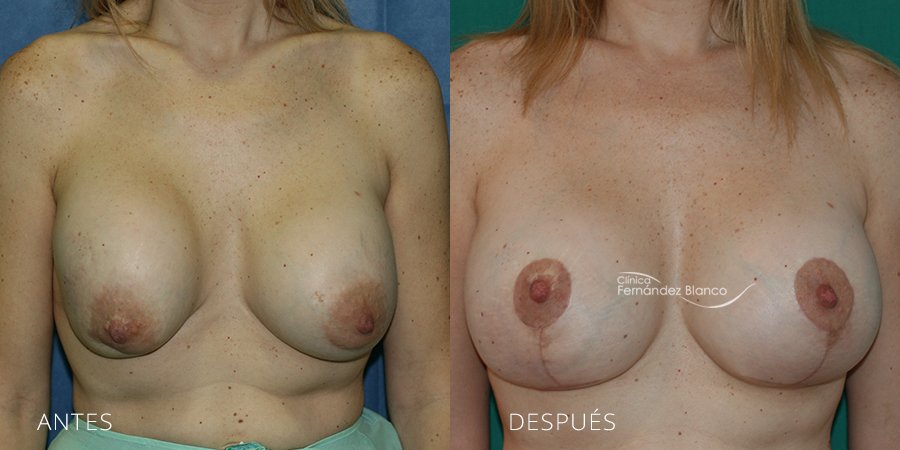
Those who undergo a mammoplasty are not always completely satisfied. This dissatisfaction may be caused by malpractice by the previous surgeon, by unforeseen congenital predispositions or simply by a change of mind on the part of the patient. Secondary surgery corrects these problems caused by a previous operation.
After a mammoplasty, it is important to monitor how the implants adapt to the body and vice versa. Over time, deficiencies with various causes may be detected.
- On the one hand, it is possible that at the time of the first procedure there was a design error. Poor placement of the implants or an error in the access route can cause stretched scars or pinching. An expert surgeon will be able to alleviate this problem through a second procedure.
- Also due to a poor decision during the first breast surgery, the patient may wish to reduce an exaggerated volume in her implants. Excessive volume can cause discomfort or deformities (for example, flattening of the nipple), which can be avoided by returning to the operating room to remove part of the volume of the implants.
- Another setback that can be solved with secondary surgery is the so-called capsular contracture. In this case, the patient will feel discomfort, hardness to the touch and stiffness. This is because, when a foreign material is introduced, the body reacts by generating a capsule around it. If there are complications, the capsule surrounding the implant thickens and begins to contract around the prosthesis, causing discomfort.
- On the other hand, some patients need secondary surgery to correct the appearance of a double fold under the breast, or an excessive lowering of the fold (the line that marks the lower limit of the breasts). This problem originates during the first procedure, when it is not detected or not taken into account that the patient has underdeveloped lower poles.
- In addition, some breast surgeries can develop into symmastia or uniboob, that is, the implants move closer together and, over time, end up joining. Although it may be due to a congenital defect, this situation occurs mainly due to malpractice during the first mammoplasty, which can nevertheless be corrected through secondary surgery.
Finally, it is important to know that the implants need to be replaced from time to time. In general, prostheses last around 10 years in perfect condition, after which it is usually advisable to renew them. Some women, when that time comes, choose to have them removed. In this case, a procedure is performed to carry out an explant.

Dr. Alfredo Fernández Blanco
The plastic surgeon Dr. Alfredo Fernandez Blanco stands out in his branch of medicine, as the best breast surgeon, he is also a pioneer in the so-called secondary surgeries or sequelae. With more than 30 years of experience and thousands of successful cases, he continues to achieve the most natural results that can be expected in a cosmetic surgery operation.